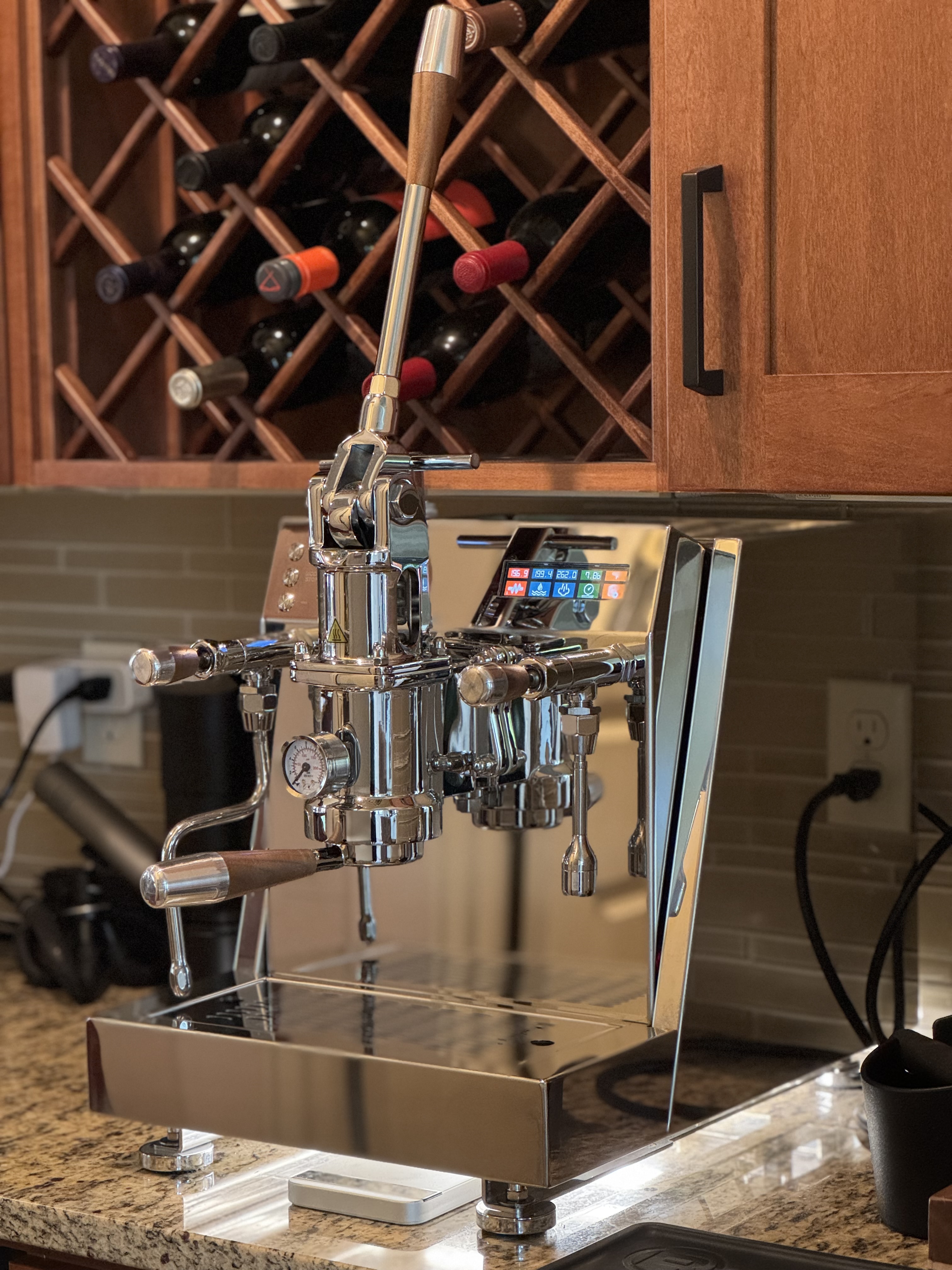
The ACS Vesuvius was my go-to machine for over eight years. The pressure profiling capabilities it had was the main reason I stuck with the Vesuvius for all of these years. In my opinion, very few espresso machines could match the experience I’ve had with it. The best espresso I ever pulled was using the Vesuvius. It was that good.
The pressure profile I used on the Vesuvius largely mimicked the falling-rate pressure of a spring-driven lever machine. This made me intrigued with the idea of a lever machine. I find them to be a wonderful blend of mechanical engineering and aesthetics. The assembly of cams, valves, and water pressure that comes from a lever and spring instead of a pump can provide a very analog experience. I view it like driving a car with a proper stick shift versus an automatic transmission. There is a bit more work, but the effort is more tactile and rewarding. And unlike most pump-driven machines, a spring-driven lever machine offers an inherent and desired falling-rate of pressure on the puck. This yields what many believe are the best shots, and what I tried to emulate with the pressure profiling capabilities of the Vesuvius.
But romance of the past can easily clash with reality. While classic lever machines had a reputation for pulling a wonderful shot of espresso, they were also known to be finicky. Temperature instability, pressure control and limited pre-infusion capabilities were just some of the reasons why they were difficult, especially in environments that favor consistency.
Modern lever machines aim to address many of those issues of the past. In the same way that synchromesh gears and automatic RPM matching on a modern stick shift rewards you with a car that is easier to drive, the lever machines of today give you the experience of a lever with the consistency found with machines using a pump.
Hello ACS Evo Leva 2
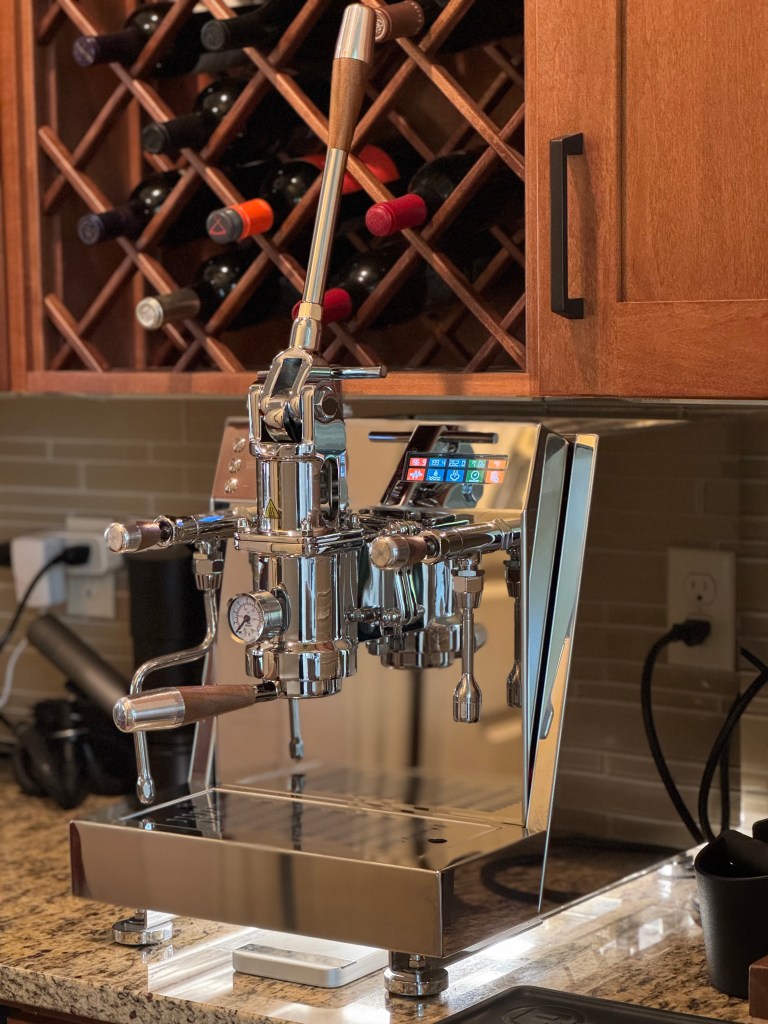
Even though there were a lot of intriguing options available, I was set on an ACS. They’ve earned my loyalty for nearly a decade through good engineering and top quality components. I was intrigued by the ACS Vostok, but sadly it would not clear the height of the overhead cabinets. The good news was that their Evo Leva 2 (officially a “Vesuvius Evo Leva” but more commonly known as an “Evo Leva”) is essentially a Vostok packaged in the chassis of a Vesuvius. The Evo Leva 2 made several improvements to the original Evo Leva by adding a dosed coffee system to manage pre-infusion better. I ordered the mirrored finish and Walnut handles, with several add-ons. The flush lever adds convenience, the LED lighting adds style, and the safety system prevents an accidental, spring-loaded upper-cut to your chin courtesy of the lever.
Observations
After one year of using the Evo Leva 2, I’ve learned a lot about the machine, and feel like this might be helpful to others. The Evo Leva 2 looks very similar to the Vesuvius, but that was where the similarities ended.
- Additional group heating element. This group heating element compliments the traditional PID driven brew boiler used to provide the heated water. The group element heats the actual group head. This results in extremely fast warmup times (15 minutes), but also allows for customized shots. For example, the brew boiler can be set to 200F (93° C) and the group boiler could be set to 192F (89° C) to simulate the behavior of a classic lever that tends to have a falling temperature rate as a shot progresses.
- Modern User Interface. This is a noticeable improvement over the Vesuvius. Displays are contemporary, bright, clear, and the touch screens work well.
- Whisper quiet. The rotary pump only runs intermittently when filling the brew chamber, and is extremely quiet when it occurs. Complete silence when pulling a shot is nice.
- Simple brew head. With a lever, there are none of the internals typically found in an E61 brew head. It is an extremely simple configuration that also helps keep maintenance to a minimum.
- Brew cut-off system. Many lever machines suffer from continuous dripping after a shot completes. The Evo Leva 2 solves this quite nicely with an automatic shutoff mechanism based on pressure, duration, or a manual button. Rarely is there ever a drip once it stops.
- Portafilter baskets. The Evo Leva 2 uses a 54mm basket. Actually it is a 53.5mm, La San Marco (LSM) style basket. While I did buy some IMS baskets, I don’t use them. I’ve always found that I prefer the Vesuvius baskets over the IMS. I find the deeper stock basket comfortably holds up to ~17.2g; I’d love an official 28–29 mm version for 18 g doses.
- Flexible pre-infusion. Pre-infusion kicks off the moment the lever is pulled down, and stops the moment the lever is released upward. But this can also be extended or manipulated with the optional flush lever.
- Steaming power. For the amount of milk that I usually steam (about 7oz or 200ml), I initially reduced the steam boiler temperature a bit to make the steaming more manageable. This is a good problem to have, given that most home units lack sufficient steam power.
- Weight. At 104 pounds (47 kg), do yourself a favor and make sure someone else is around while you are moving it. Your coffee may not taste quite as good after a hernia.
One difference that really stands out from tradition pump driven machines is the connection you have to the coffee and puck preparation. Pump driven machines push a flow out based on a specific pressure – good, bad, or ugly. A spring lever applies that force of water to the puck by a spring at a declining pressure. The result is a much better feel for the characteristics of the coffee – its freshness, whether or not your grind size is correct, etc.
Workflow
When turning on the machine, the main display to the right side of the machine will present the following, from left to right.
- Group head temperature.
- Brew boiler temperature.
- Steam boiler temperature.
- Pre-infusion and brew pressure.
- Next page button. This presents additional options, including turning the machine off.
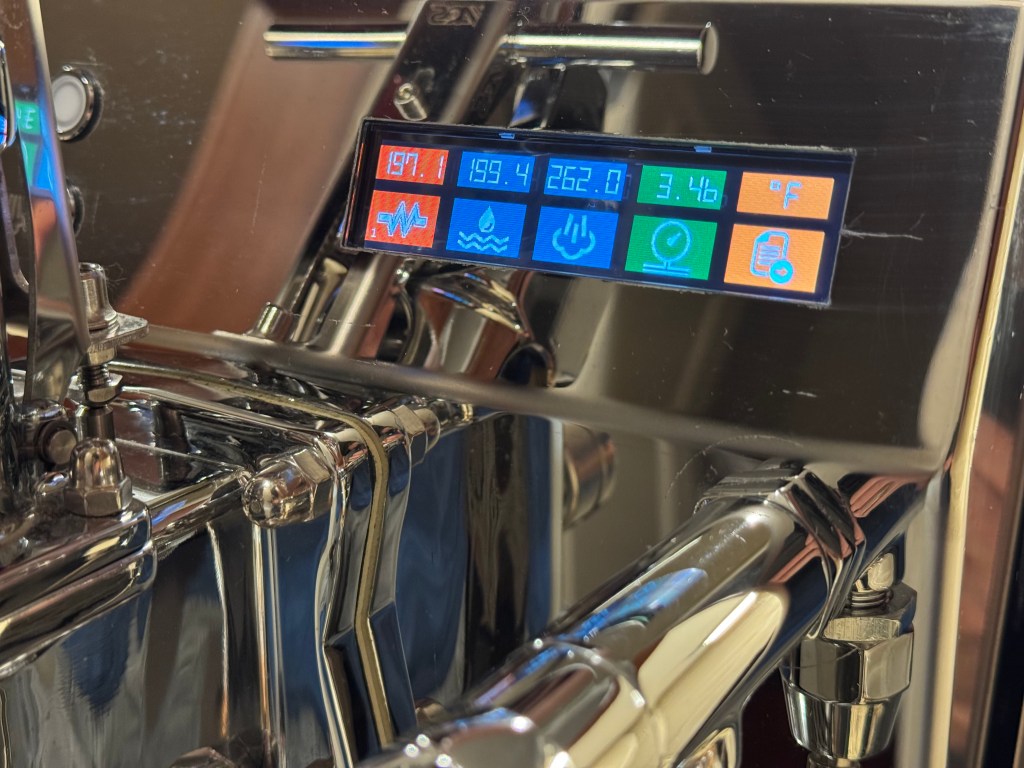
Once the machine is up to temperature, it is ready to pull a shot. I left the default pre infusion pressure at 2.4b, as I didn’t find a need to change it. For a pre-infusion time, I control this by how long the lever is down, which for me is between 8-10 seconds.
As pre-infusion completes, I slowly let the lever up over the cam to engage the spring, the shot starts out at about 11.1b of pressure, and will end with between 7.6 to 8.2b of pressure. More on this in a moment. Given the 17g dose, I look for a target output of about 35 grams with a shot time of 30 seconds. This results in a total time from lever down to shot completion of about 40 seconds. It’s a nice round number to shoot for that produces excellent results.
The shot will end courtesy of its brew cut-off system. You can set this to cut-off based on the pressure, the duration of the shot, or using the “stop” button on the left hand side of the machine. I choose to have it end the shot based on pressure, as the manual suggests. However, if we stop the shot based on the weight of the shot, (e.g. 35g), the ending pressure may vary a bit. This variance does not occur on a shot-by-shot basis, but related to variables that change more slowly, such as the bean type, the age, grind size and the roast level. I’ve configured my machine to cut the shot when it hits 7.6b. But if the weight of the shot reaches 35g, and it is still at say, 7.9b, I’ll simply tap the stop button. The cut-off value is easy to adjust, so if I roast a large batch of a single source bean, I will adjust the cut-off pressure to match whatever the gauge showed at 35 grams of output.
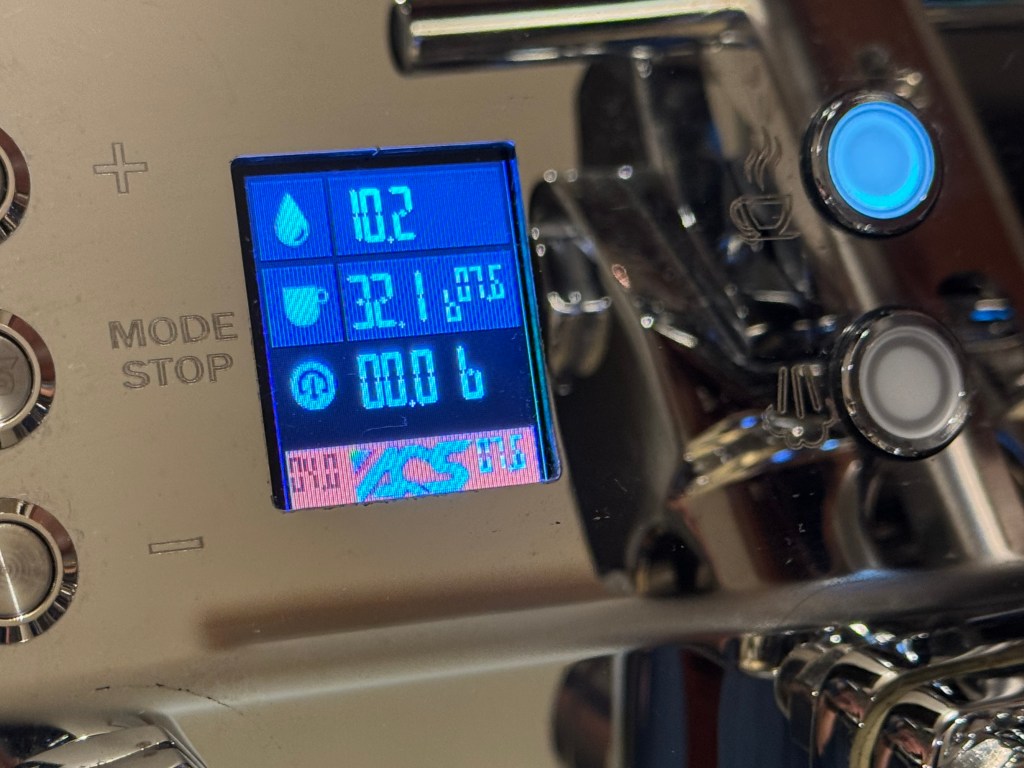
Quick tip: While it is not uncommon to adjust your grind size to make small adjustments to your flow rate, with the Evo Leva 2, you can adjust this flow rate to shave a few seconds off or add a few seconds to your pre-infusion time. This will change the resistance of the puck so that you can fine tune your shot. Shorter pre-infusion time (e.g. 4-5 seconds) produces a longer running shot, longer pre infusion time (e.g. 9-10 seconds) produces a shorter running shot.
Summary
I had fears that I would not like the Evo Leva 2 as much as the Vesuvius. But in reality, I like the Evo Leva 2 more. It is nearly perfect. It does everything well. Paired with my Femobook A68 conical grinder, the result is as good as I could hope for.
– Pete

 Engineering Espresso